
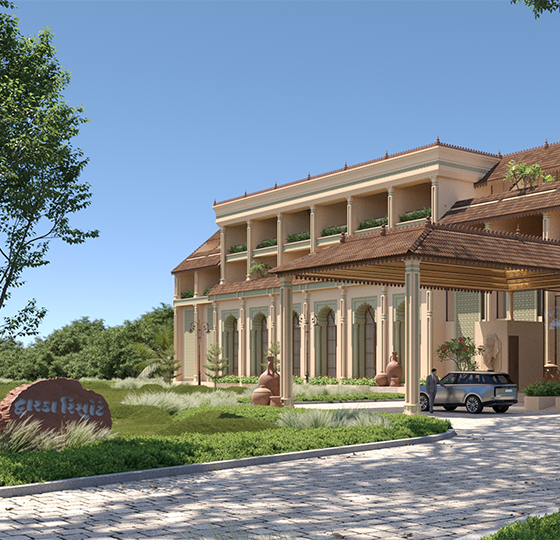
The Dwarka Resort Development, located in Gujarat, is envisioned as a large-scale hospitality destination that integrates architecture, landscape, and leisure into a cohesive and immersive experience. Designed as a contemporary resort environment, the project reinterprets traditional hospitality principles through a modern planning approach, creating a destination that balances luxury, comfort, and spatial fluidity.
Spread across a substantial site of approximately 210,000 sq. ft., the master planning organizes built and open spaces into a layered composition of public, semi-private, and private zones. The layout is structured to guide visitors through a carefully curated journey—from arrival and reception to residential villas and recreational amenities—ensuring both orientation and experiential richness.
At the heart of the development lies the main building, which accommodates key functions such as reception, banquet halls, restaurant, and administrative spaces. This central spine acts as the anchor of the resort, seamlessly connecting to surrounding villa clusters, landscaped gardens, and water features.
The villa units are designed as intimate retreats, offering privacy while maintaining visual and physical connectivity with the larger landscape. Each unit is complemented by extended garden spaces, decks, and proximity to water bodies, enhancing the overall resort experience.
A defining element of the project is its integration of water and landscape. Swimming pools, deck areas, and open lawns are strategically distributed across the site, creating a network of leisure spaces that enhance microclimate and visual continuity. Event spaces and party lawns further activate the site, allowing for both private relaxation and large-scale gatherings.
The architectural language is contemporary yet contextual, characterized by clean forms, horizontal massing, and a restrained material palette. The design prioritizes openness, with large glazed surfaces and transitional spaces that blur the boundaries between indoor and outdoor environments.
Spatial planning is driven by efficiency and experience. Service areas, circulation routes, and guest zones are carefully segregated to ensure smooth operations without disrupting the user experience. The inclusion of amenities such as spa, gym, sports areas, and wellness facilities reinforces the project’s positioning as a holistic resort destination.
Ultimately, the Dwarka Resort Development is conceived as more than just a hospitality project—it is a spatial narrative that combines architecture, landscape, and leisure into a unified experience. The project reflects a contemporary vision of resort living, where design is used as a tool to create immersive, memorable, and luxurious environments.