
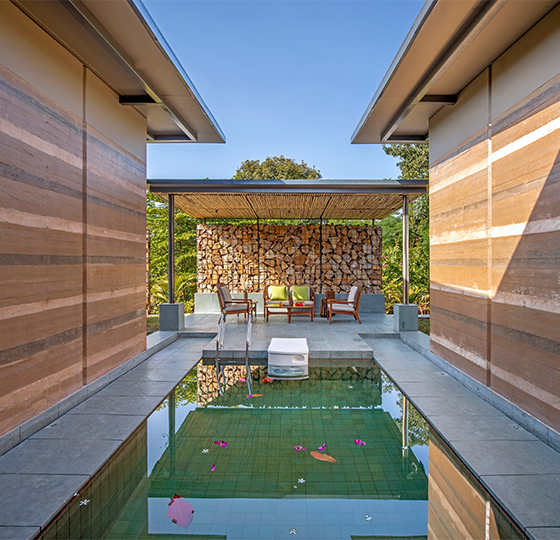
The interior design of The Earth House in Halol is conceived as a natural extension of its sustainable architectural philosophy, where material honesty, environmental responsiveness, and spatial simplicity define the living experience. Designed by Art & Architecture Associates, the interiors embrace a minimal yet deeply tactile approach, creating spaces that are both functional and emotionally grounded.
At the core of the interior language is the exposed rammed earth construction, which becomes both a structural and experiential element. The natural textures and warm tonal variations of the earth walls establish a calming and immersive environment, eliminating the need for excessive finishes while reinforcing a strong connection to the site.
The spatial planning of the interiors is guided by simplicity and efficiency. Open and fluid layouts allow for seamless transitions between living, dining, and private spaces, enhancing both usability and spatial continuity. Large openings and carefully positioned windows ensure abundant natural light and cross ventilation, creating interiors that feel airy, comfortable, and energy-efficient.
Material selection is intentionally restrained, focusing on locally sourced and sustainable materials. Natural stone, wood, and earthy finishes complement the rammed earth walls, resulting in a cohesive palette that is both timeless and contextually appropriate. The absence of excessive ornamentation allows the inherent beauty of materials to take precedence.
Furniture and interior elements are designed to align with the overall philosophy of minimal living. Clean lines, functional layouts, and handcrafted details define the furniture language, ensuring comfort while maintaining visual lightness. The interiors avoid clutter, instead promoting a lifestyle that is intentional and closely connected to nature.
Passive design strategies play a crucial role in shaping the interior environment. The thermal mass of the walls regulates indoor temperatures, while natural ventilation reduces dependence on artificial systems. This results in interiors that remain significantly cooler and more comfortable, even in the hot climate of Gujarat.
The relationship between interior and exterior is seamless, with visual connections to the surrounding landscape, organic farms, and green zones. Outdoor elements such as courtyards, shaded areas, and leisure spaces extend the living experience beyond the built form, creating a holistic and immersive environment.
Ultimately, the interiors of The Earth House represent a refined expression of sustainable living—where simplicity, material authenticity, and environmental consciousness come together. The project stands as a testament to how interior design can move beyond aesthetics to create meaningful, responsible, and enduring spaces.